Table of Contents
- Why Teaching Veterans Requires a Different Approach
- Supporting Military-Connected Students: Who They Are and What They Bring
- Trauma-Informed Teaching Strategies That Work
- Classroom Management for New Teachers Working With Veterans
- Building Trust and Transparency With Student Veterans
- Digital Accessibility and Asynchronous Learning Options
- Peer Mentorship and Career-Integrated Pedagogy
- Conclusion: Practical Steps for Teaching Veterans
- Frequently Asked Questions
Last Updated: September 18, 2026
Why Teaching Veterans Requires a Different Approach
Veterans bring discipline, maturity, and real-world experience to the classroom, but they often learn differently from traditional students, which is why effective teaching strategies for veterans matter. Effective teaching strategies for veterans start with understanding that difference. This guide from Gunny Mac Books draws on Steven Walker, a former Infantry Officer and educator, to show what works.
Supporting Military-Connected Students: Who They Are and What They Bring
Military-connected students are learners who serve or have served in the armed forces, plus their family members. Student veterans are the largest group.
Strengths Veterans Bring to the Classroom
- Leadership skills built in high-pressure situations
- Discipline and follow-through on deadlines
- Maturity that steadies group work
- Resilience after setbacks and failure
- Real-world context for abstract ideas
These traits show up in discussions, projects, and peer mentoring. A veteran in a study group often becomes its quiet anchor.
Common Transition Challenges from Service to School
The shift from service to school is not always smooth. A few patterns recur:
- Sitting still in a lecture feels passive after active duty
- Younger classmates can feel hard to relate to
- Group projects move slower than a military timeline
- Asking for help can feel like weakness
Trauma-Informed Teaching Strategies That Work
Trauma-informed teaching designs instruction that avoids re-triggering past harm while keeping academic standards high. It does not lower the bar; it removes needless friction.
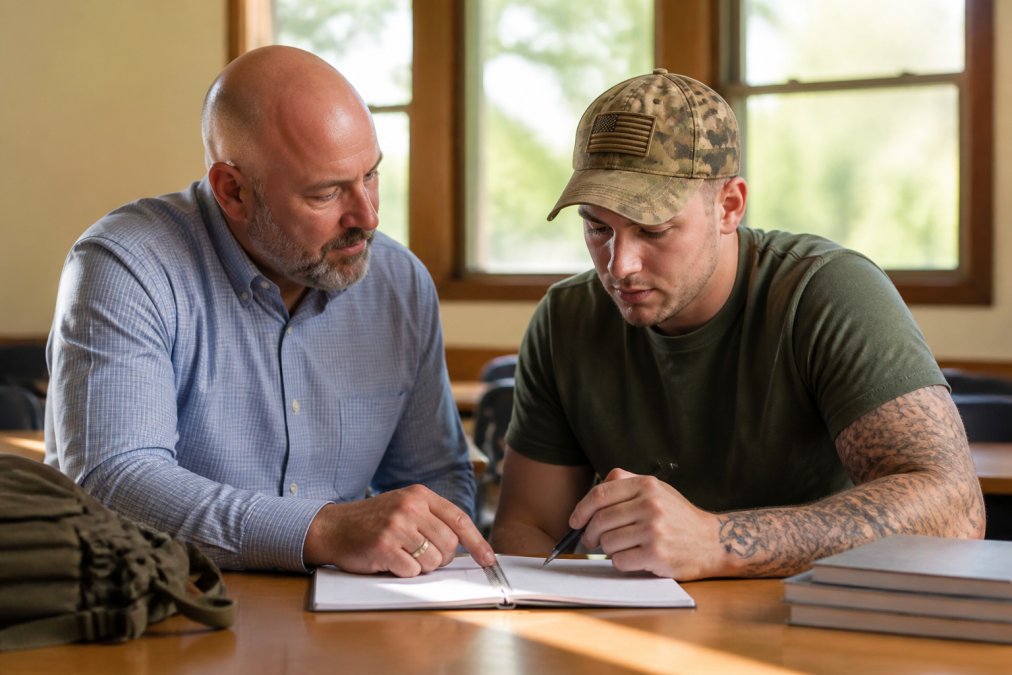
Simple moves matter more than big programs:
- Give a heads-up before loud videos, sirens, or sudden group work
- Offer a quiet way to step out without drawing attention
- Let students choose how they participate in discussions
- Keep tone calm and predictable
- Seat students near the door when they ask, so leaving and returning draws less notice
- Avoid standing directly behind a seated student during one-on-one help
Recognizing Invisible Disabilities and Triggers
Not every challenge is visible. Traumatic brain injury, hearing loss, and post-traumatic stress often show no outward sign. A disengaged student may be struggling with noise, memory, or sleep; one who misses class may be dealing with something you cannot see.
Specific Accommodations That Actually Help
Most guides stop at “be trauma-informed” and never say what to do on Tuesday. These concrete, low-cost adjustments map to the conditions veterans most often bring into a classroom. None require a formal accommodation letter, and none lower academic rigor.
For traumatic brain injury (TBI):
- Break multi-step assignments into numbered checkpoints with separate due dates
- Allow extended time on timed quizzes without requiring a documented plan first
- Permit a single-page reference sheet on exams that test application, not recall
- Reduce background noise during independent work, close the door, mute hallway traffic
- Repeat key instructions in writing at the end of class, not just verbally
For post-traumatic stress:
- Replace surprise cold-calling with a standing option to pass
- Warn the class before any content involving combat, casualty, or emergency response
- Offer an alternative assignment when a reading or film is likely to be a trigger
- Let students choose their own seat and keep it for the term
- Avoid physical positioning that blocks the exit
For hearing loss and tinnitus:
- Face the class when speaking; do not lecture while writing on the board
- Use a lapel mic or classroom amplification if one is available
- Turn on captions for every video, even short ones
- Provide a written summary of verbal announcements
- Seat the student away from HVAC vents and other steady noise
For memory and executive-function challenges:
- Post the week’s schedule in the same place every week
- Use the same assignment template all term so the format is predictable
- Send a reminder 48 hours before each major deadline
- Allow outlines and drafts to be submitted for feedback before the final version
Ask “What would make this work better for you?” instead of “Do you need accommodations?” The first question gives the student control. The second puts them on the spot. A follow-up that works well: “Here are three options, pick whichever fits.” Choice reduces the cost of asking.
What Not to Do
A few well-intentioned moves backfire. Do not single a student out as the class expert on war or military life. Do not require public disclosure to justify an accommodation. Do not assume a student who seems fine is fine, many veterans manage symptoms privately. And do not treat a request for flexibility as a request for a lower grade; the two are separate.
Calling out a veteran in front of the class to “share war stories” backfires. It turns a person into a prop. Some students will shut down for the rest of the term.
Documenting Without Diagnosing
Instructors are not clinicians, and the goal is not to label anyone. Keep a private log: date, what you observed, what you offered, what the student chose. If a pattern persists, refer the student to the campus office handling military-connected services, disability services, or counseling. Handing off is not abandoning the student; it connects them to people whose job is to help, while the instructor keeps the classroom workable.
Classroom Management for New Teachers Working With Veterans
Classroom management for new teachers gets harder when a student has more life experience than the instructor. Confidence, not control, is the answer.
A few habits that work:
- State the plan for each class at the start
- Keep instructions short and direct
- Address disruption in private, never as a public callout
- Praise effort and precision, not just results
Building Trust and Transparency With Student Veterans
Trust is the foundation of any classroom culture. With student veterans, it must be earned through transparency.
Small acts build big credibility:
- Post your grading rubric before the first assignment
- Return work on the day you promised
- Admit mistakes quickly and without drama
Digital Accessibility and Asynchronous Learning Options
Online and hybrid formats can be a lifeline for military-connected students juggling jobs, family, and medical appointments. Flexible options keep them enrolled.
Build courses with accessibility in mind from the start:
- Caption every video
- Use readable fonts and high contrast
- Offer text versions of slides
- Allow assignment submission in more than one format
Flexibility is not a favor. It is a retention tool. Students who can keep up are students who stay enrolled.
Peer Mentorship and Career-Integrated Pedagogy
Two approaches do more than most formal programs: peer mentorship and career-integrated teaching. Most guides mention both and stop. Here is how to run them inside a single course, without a budget or a new department.
Veteran-to-Veteran Peer Mentorship Inside a Course
Nearly every teaching guide treats mentorship as something the instructor does to the student. The stronger model is veteran-to-veteran: a student further along supports a student just starting. The instructor sets up the structure, then gets out of the way.
A workable structure for a single term:
- Recruit two to four mentors from students who have already completed the course. Offer a small incentive, a letter of recommendation, a line on a resume, or course credit where the department allows it.
- Pair by program, not by branch. A student in the same major or the same transfer path is more useful than a student who simply shares a service background.
- Set a fixed cadence. A 20-minute check-in every other week beats an open-ended “reach out anytime.” Open-ended offers rarely get used.
- Give mentors a short script. Three questions: What is coming up that you are unsure about? What did you get stuck on last week? What do you need before the next class?
- Keep the instructor out of the middle. Mentors report only whether the pair met. They do not report grades, personal disclosures, or problems.
- Rotate at midterm. If a pairing is not working, reassign without asking either student to explain.
Career-Integrated Pedagogy That Uses Military Skills
Career-integrated teaching ties coursework to real professional goals. The underused move is to start from skills the student already has, leadership, logistics, technical training, operations planning, and build the assignment backward.
Concrete substitutions that work in common courses:
- Composition: replace a generic persuasive essay with a professional memo or an after-action review of a decision the student has actually made
- Research methods: let the student choose a topic tied to a field they want to enter, then require a one-page translation of the findings for a non-expert audience
- Public speaking: swap the standard informative speech for a briefing format, situation, mission, execution, assessment, which most veterans already know cold
- Project management: use a real team task and require a written plan with milestones, owners, and a risk section
- Data or statistics: use a dataset the student can interpret through a work context they already understand
A Simple Course-Level Model
| Approach | What It Does | Best For |
|---|---|---|
| Veteran-to-veteran peer mentorship | Pairs new students with experienced peers on a fixed schedule | First-year transition |
| Career-integrated projects | Links classwork to job skills and prior service experience | Juniors and seniors |
| Cohort study groups | Builds steady academic support across a term | Any level |
| Faculty office hours | Gives one-on-one guidance | Students who hesitate to ask |
These models also support retention: students who feel connected finish at higher rates. No formal program is needed to start, one pairing and one revised assignment is enough to test the model in a single term.
Mentorship works when it is scheduled, paired by program, and opt-in. Career-integrated work works when it starts from what the student already knows. Both are cheap, both are repeatable, and both are missing from most teaching guides.
Conclusion: Practical Steps for Teaching Veterans
Teaching veterans well comes down to respect, clarity, and flexibility. Start with the small moves: clear rules, quiet options, honest communication.
Frequently Asked Questions
How can teachers support military-connected students in the classroom?
Start by learning who your military-connected students are without making them announce it publicly. Offer flexible deadlines, quiet spaces for test-taking, and clear written instructions. Connect them with campus veteran services and peer mentorship programs. Avoid calling them out in front of the class. Instead, build trust through consistent communication and transparency about your expectations. Small adjustments to classroom culture make a measurable difference in retention and engagement.
What are the best trauma-informed teaching practices for veterans?
Trauma-informed teaching for veterans means recognizing that hypervigilance, difficulty with authority figures, and sensitivity to sudden noises or confrontation are common. Give advance notice before fire drills or loud activities. Avoid surprise graded participation. Use predictable routines and offer choices in assignments. When a student seems disengaged, check in privately rather than issuing a public correction. These strategies reduce stress without lowering academic standards.
How does military experience translate to effective classroom management?
Veterans often bring discipline, leadership skills, and maturity that strengthen classroom culture. Many naturally step into collaborative learning roles and help peers stay on task. Their experience with structured environments means they respond well to clear expectations and consistent consequences. Teachers can use this by assigning leadership roles in group work and asking veterans to mentor classmates. The key is channeling those strengths without treating them as a monolith.
What challenges do student veterans face when transitioning to civilian education?
The service-to-school transition often involves navigating unfamiliar academic norms, younger peer groups, and bureaucratic processes like GI Bill certification. Some veterans deal with invisible disabilities such as PTSD or traumatic brain injury that affect concentration. Others feel isolated because classmates cannot relate to their experiences. Faculty development on veteran transition and accessible instructional design helps instructors recognize these challenges early and connect students to support services before problems escalate.
The hardest part of teaching veterans is not the content. It is earning trust fast enough to matter. Gunny Mac Books was built for exactly that challenge, with a teacher’s survival guide written by someone who led soldiers and stood in front of a classroom. Explore the guide and the noir detective novels that bring the same voice to the page. Get started with Gunny Mac Books and put these strategies to work this week.