Table of Contents
- Why the 1940s Still Captivates Readers
- WWII Historical Mystery Novels: Suspense on the Front Lines
- The Best Noir Detective Books Set in the 1940s
- 1940s Fiction Without War: Homefront and Domestic Stories
- Global Perspectives: 1940s Stories Beyond the European Theater
- How to Write Historical Fiction Set in the 1940s
- Conclusion
- Frequently Asked Questions
Last Updated: September 13, 2026
Why the 1940s Still Captivates Readers
The 1940s compresses more human drama into ten years than most centuries manage, which is why historical fiction 1940s readers keep coming back (Fiction Publishers From A to Z: Strategies, Opportunities, Successes). According to a National WWII Museum overview of the war years, the Second World War touched nearly every family on earth, which is one reason historical fiction set in the 1940s keeps pulling readers back. At Gunny Mac Books, we’ve watched that appetite up close: readers want the decade’s texture, not just its battles.
Historical fiction set in the 1940s is a literary genre that places fictional characters inside the real events, culture, and daily life of the years between 1940 and 1949. The category spans battlefield thrillers, homefront family sagas, noir detective novels, and quiet domestic dramas.
That range is exactly why the decade rewards careful browsing. A reader hunting for a gritty mystery and a reader hunting for a story about a factory town are both looking for 1940s fiction, but they want very different books.
Below, we break down twelve titles across six categories, plus a short guide to writing in this period yourself. The list leans deliberately toward mysteries and noir, but we’ve included non-war stories and global perspectives that most roundups skip.
WWII Historical Mystery Novels: Suspense on the Front Lines
The strongest WWII historical mystery novels use the war as pressure, not decoration. Espionage, occupation, and shifting loyalties give a detective story stakes that a peacetime case can’t match.
Alan Furst built a career on this. His Night Soldiers series follows a cast of European intelligence operatives across the 1930s and 1940s, moving through Paris, Moscow, and the Balkans with a historian’s eye for atmosphere. Furst’s prose is understated, almost cold, and that restraint is the point: his protagonists survive by noticing details.
Philip Kerr’s Bernie Gunther novels take a different route. Gunther is a Berlin homicide detective who works cases under a regime he despises, and Kerr uses him to examine moral compromise up close. The early books sit squarely in the 1930s, but the series carries into the war and post-war years, making it essential reading for anyone tracking the decade through crime fiction.
A common mistake readers make is expecting these books to be action-heavy. They aren’t. The tension comes from surveillance, negotiation, and the constant risk of saying the wrong thing to the wrong person.
When a WWII mystery feels flat, it’s usually because the war is scenery rather than a character. The best books in this subgenre make the conflict shape every decision the protagonist makes, from who they trust to whether they report a crime at all.
The Best Noir Detective Books Set in the 1940s
The best noir detective books set in the 1940s are defined by mood as much as plot: rain-slicked streets, compromised cops, and a protagonist whose code costs them something. The decade gave noir its definitive look, and novelists have been mining it ever since.
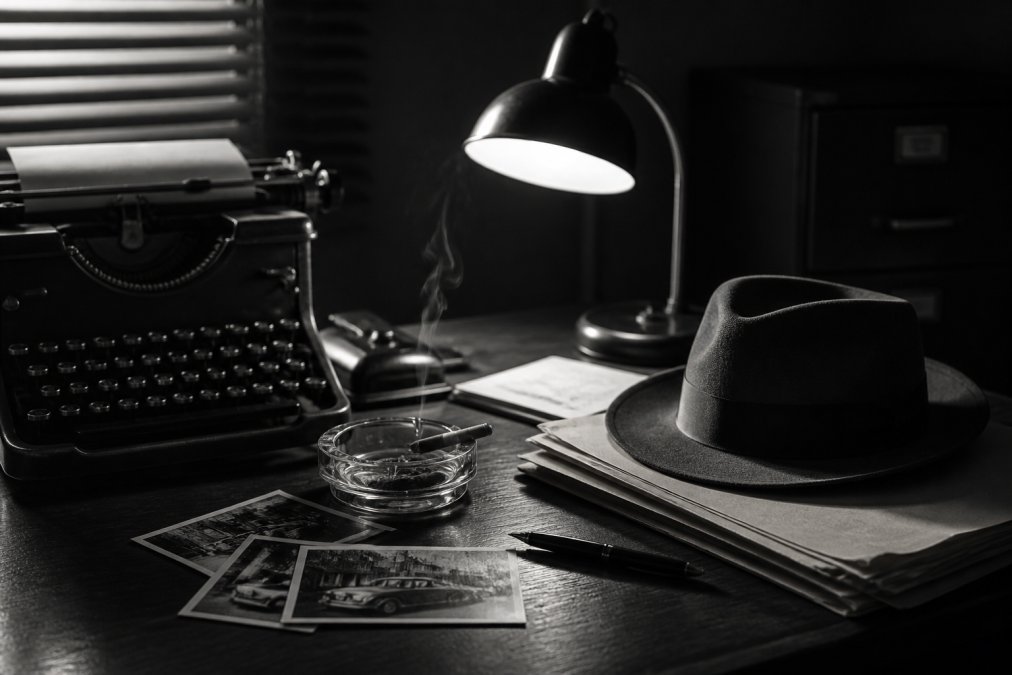
James Ellroy’s The Black Dahlia is the most ambitious entry here. Ellroy takes a real 1947 Los Angeles murder and builds a fictional investigation around it, layering in police corruption, obsession, and a city changing faster than its institutions can handle. The prose is clipped and strange, and the book is less a whodunit than a portrait of a department rotting from the inside.
Megan Abbott’s Die a Little works at the opposite scale. Set in 1950s-adjacent Los Angeles and steeped in 1940s noir conventions, it follows a schoolteacher drawn into her new sister-in-law’s shadowy world. Abbott’s interest is in women who get written out of noir, and the result reads like a classic film shot from a different angle.
| Book | Author | Type | Best For |
|---|---|---|---|
| Night Soldiers series | Alan Furst | Espionage | Readers who want atmosphere over action |
| Bernie Gunther novels | Philip Kerr | Detective | Moral complexity under a brutal regime |
| The Black Dahlia | James Ellroy | Noir crime | Sprawling, dark historical crime |
| Die a Little | Megan Abbott | Noir drama | Character-driven noir with a fresh lens |
1940s Fiction Without War: Homefront and Domestic Stories
Plenty of great 1940s fiction never leaves the kitchen table. Homefront and domestic novels focus on rationing, factory shifts, letters from overseas, and the slow rearrangement of family life while the world burns elsewhere. This is the category most “best of the 1940s” lists under-serve, and it’s where patient readers find the quietest, most affecting books.
Here are concrete starting points, all set in the decade and none built around combat:
- A Tree Grows in Brooklyn by Betty Smith (1943). Published during the war but set in the 1910s, it is often shelved with 1940s fiction because it defined the decade’s working-class domestic voice. Read it for the template: a family scraping by, told through small humiliations and small victories.
- The Group by Mary McCarthy (1963). Follows eight Vassar graduates from the 1930s into the 1940s, tracking careers, marriages, birth control, and the gap between what women were trained for and what the decade allowed them to do.
- The Man in the Gray Flannel Suit by Sloan Wilson (1955). Set in the early 1950s but saturated with 1940s aftermath: a returning veteran, a suburban mortgage, and a wartime secret that won’t stay buried.
- A Town Like Alice by Nevil Shute (1950). A British woman’s war years in Malaya and her post-war attempt to build a life in the Australian outback. The war is present, but the story is about endurance, not battle.
- The End of the Affair by Graham Greene (1951). A London love triangle during and after the war, structured around bombed streets and rationed lives rather than front-line action.
What these books share is a mechanism: the war works as an offstage pressure that reshapes ordinary decisions. A ration book changes what a family eats. A missing letter changes who a woman marries. A factory shift changes when a mother sees her children. That is the engine of homefront fiction, and it is harder to write than a battle scene because there is nowhere to hide behind spectacle.
When you’re browsing for 1940s fiction without war themes, look for novels that treat the period as a setting rather than a plot device. The conflict may be in the background, but the story belongs to the characters. A useful filter: if you can summarize the book without mentioning a battle, a spy, or a soldier, you’ve found the right shelf.
If you want the decade’s texture without the front line, start with A Tree Grows in Brooklyn and The Group back to back. One shows the 1940s inheritance from below; the other shows what the decade’s educated women did with it.
Global Perspectives: 1940s Stories Beyond the European Theater
Most 1940s reading lists stay in London, Paris, and Berlin. That’s a narrow slice of a genuinely global decade. The war was fought and lived across the Pacific, North Africa, South Asia, and Latin America, and the fiction from those vantage points asks different questions about loyalty, occupation, and survival.
The Pacific and Asia. The Pacific theater produced a distinct literary tradition: heat, jungle, exhaustion, and an enemy that never quite resolves into a face. James Jones’s The Thin Red Line (1962) is the canonical American novel of Guadalcanal, and it is worth reading alongside the nonfiction it draws on. For the occupation of Asia from the other side, The Narrow Road to the Deep North by Richard Flanagan (2013) follows Australian prisoners on the Burma Railway and the men who guarded them, and it refuses to let either group off the hook. In Empire of the Sun by J. G. Ballard (1984), a British boy survives internment in Shanghai, and the novel’s real subject is how quickly civilization strips away.
South Asia. A Town Like Alice by Nevil Shute (1950) spends its middle third on a forced march of British women through occupied Malaya, then follows its heroine to postwar Australia. It is one of the few widely read novels that treats the Malayan campaign as lived experience rather than a footnote.
Latin America and the Caribbean. This is the thinnest shelf of all, which is exactly why it is worth seeking out. The Feast of the Goat by Mario Vargas Llosa (2000) is set in the Dominican Republic under Rafael Trujillo, whose regime spanned the 1940s; the novel moves between the dictator’s final years and the assassination that ended them. For a Caribbean perspective on the war years, The Black Jacobins by C. L. R. James (1938) is history rather than fiction, but it shaped how a generation of Caribbean writers imagined the 1940s, and its influence shows in later novels from the region.
Africa. The English Patient by Michael Ondaatje (1992) moves between an Italian villa, the North African desert, and Cairo, and its central characters are a Hungarian mapmaker, a Sikh sapper, and a Canadian nurse. It is one of the few widely read 1940s novels in which the European theater is the periphery.
Gunny Mac Books’ own Gunnery Sergeant Mac stories draw on the Pacific tradition. Mac led the first machine gun squad to hold Edison’s Ridge at Guadalcanal in 1942, and that setting gives the noir plotting a heat and exhaustion you don’t get from a European backdrop. If you’ve read a lot of war fiction set in France, the Pacific is where the genre still feels fresh.
The 1940s were fought and lived on every continent. A reading list that never leaves Europe is missing half the decade’s stories. Start with The Thin Red Line for the Pacific, The English Patient for North Africa, and The Feast of the Goat for a Latin American regime that the war barely touched but the decade still shaped.
How to Write Historical Fiction Set in the 1940s
Writing historical fiction 1940s stories comes down to research discipline and restraint. The period is close enough that readers have living memory of it, and far enough that small errors break immersion fast.
Start with the physical world. What did your characters eat, wear, and hear? Ration books, streetcars, radio serials, and the specific slang of the year all anchor a scene. Then get the timeline right: 1942 and 1945 are not interchangeable, and the mood of a town shifts with each year of the war.
A few practical rules we follow:
- Pick a specific year and month. General “1940s” settings read vague. Anchoring to a date forces accuracy.
- Research the boring details. Pay scales, bus routes, and ration amounts do more for authenticity than dramatic set pieces.
- Let the period limit your characters. What they can’t do or say is as revealing as what they can.
- Read primary sources. Newspapers, letters, and oral histories beat secondhand summaries.
The most common mistake is treating the decade as a single mood. A story set in 1941 feels nothing like one set in 1948, and readers who lived through it will notice immediately.
For a deeper look at period accuracy and noir craft, the Library of Congress research guides on 20th-century American history are a solid starting point.
Conclusion
Finding 1940s fiction that matches your mood, whether that’s a hardboiled mystery, a homefront drama, or a Pacific war story, takes more than a generic best-of list. Gunny Mac Books publishes noir detective novels steeped in authentic 1940s detail, written by Steven Walker, a former Infantry Officer and educator whose Gunnery Sergeant Mac stories bring the Pacific theater and wartime Cleveland to life. If you want immersive period mysteries with real historical grounding, start with the Mac novels and see where the decade takes you.
Frequently Asked Questions
What makes the 1940s such a popular setting for historical mystery novels?
The 1940s offers a unique backdrop of social change and global conflict, creating natural tension for mystery plots. The noir genre, which flourished in this decade, pairs perfectly with stories of espionage and resistance. The atmosphere of uncertainty and moral ambiguity provides fertile ground for complex characters and suspenseful narratives, making it a rich setting for historical fiction.
Are there good historical fiction books set in the 1940s that don’t focus on the war?
Absolutely. While many stories center on WWII, there’s a growing collection of 1940s fiction exploring civilian life, domestic dramas, and social change. These novels offer a different perspective on the decade, highlighting everyday life and character-driven stories.
How do authors balance historical accuracy with suspense in 1940s fiction?
Authors achieve this balance through meticulous historical research and a focus on character. They ground the narrative in authentic details of the era, such as period-specific language, technology, and social norms, which builds trust. The suspense is then driven by the protagonist’s personal stakes and choices within that historically accurate framework, making the story feel both real and thrilling.
What defines a ‘military mystery’ in the context of 1940s historical fiction?
A military mystery blends the procedural elements of a detective story with a military setting or context. In 1940s fiction, this often involves a protagonist in the armed forces or intelligence community investigating a crime, like a murder or theft, against the backdrop of WWII. The genre explores themes of duty, honor, and the moral complexities of war while delivering a compelling puzzle.
The 1940s offer more range than most readers expect, and the right book depends entirely on whether you want suspense, atmosphere, or a quiet domestic story. Gunny Mac Books delivers gritty noir detective fiction with authentic 1940s settings, from Guadalcanal to the homefront, backed by an author with two decades of military experience. Get started with Gunny Mac Books and find your next immersive read.