Table of Contents
- What Makes a Military Background Noir Mystery Novel Work
- Quick Comparison: 7 Military Background Noir Mystery Novels
- 1. Gunny Mac Books: Authentic 1940s Military Historical Fiction
- 2. James Ellroy’s 1940s L.A. Noir Collection: Hardboiled Detective Novels at Their Peak
- 3. The French Illusion by John Grisham: Military-Intelligence Meets Political Thriller
- 4. The Death of Us: Award-Winning Fatalism and Moral Ambiguity
- 5. A Gift Before Dying by Malcolm Kempt: Modern Veteran Noir
- 6. A Killer in Paradise by Tom Hindle: Classic Mystery Structure with a Modern Twist
- What Most Guides Get Wrong About Veteran Noir
- The Bottom Line
- Frequently Asked Questions
Last Updated: September 20, 2026
What Makes a Military Background Noir Mystery Novel Work
A military background noir mystery novel works when combat experience collides with moral ambiguity, producing a protagonist who solves crimes the way soldiers survive: through tactical thinking, hard-won instinct, and a fatalism born of war. This guide examines what makes a military background noir mystery novel work.
Noir has always been a genre of damaged people making compromised choices. Adding a military background sharpens the stakes. The veteran protagonist brings a specific toolkit to the investigation: tactical skills, procedural discipline, and combat experience that most private investigators simply don’t have. But that same background creates the genre’s richest tension. A soldier trained to follow orders now works in a world of corrupt institutions and shadowy figures where no order is clean.
The best military background noir mystery novels don’t treat war as backstory decoration. They let post-traumatic stress, survivor’s guilt, and existential dread shape how the detective reads a crime scene, questions a witness, and ultimately decides what justice looks like. That psychological weight is what separates gritty realism from a generic detective story wearing a uniform.
Crime Writers of America genre resources maintains that the strongest crime fiction ties character history directly to investigative method, and veteran noir is the clearest example of that principle at work.
Quick Comparison: 7 Military Background Noir Mystery Novels
| Title | Setting | Noir Style | Best For |
|---|---|---|---|
| Gunny Mac Books | 1942 Guadalcanal, 1943 Cleveland | Authentic period noir | Readers wanting real military detail |
| James Ellroy’s 1940s L.A. Collection | Postwar Los Angeles | Hardboiled, cynical | Fans of classic noir atmosphere |
| The French Illusion | Pentagon, military intelligence | Political thriller | Military-political intrigue |
| The Death of Us | Contemporary | Fatalistic, award-winning | Literary crime fiction fans |
| A Gift Before Dying | Modern day | Fast-paced suspense | Readers who want modern pacing |
| A Killer in Paradise | Atmospheric setting | Classic whodunit | Traditional mystery lovers |
1. Gunny Mac Books: Authentic 1940s Military Historical Fiction
A convincing veteran protagonist in the genre often comes from someone who lived the world he writes about. Gunny Mac Books is the creation of Steven Walker, a former Infantry Officer with two decades of military experience, and that background shows on every page.
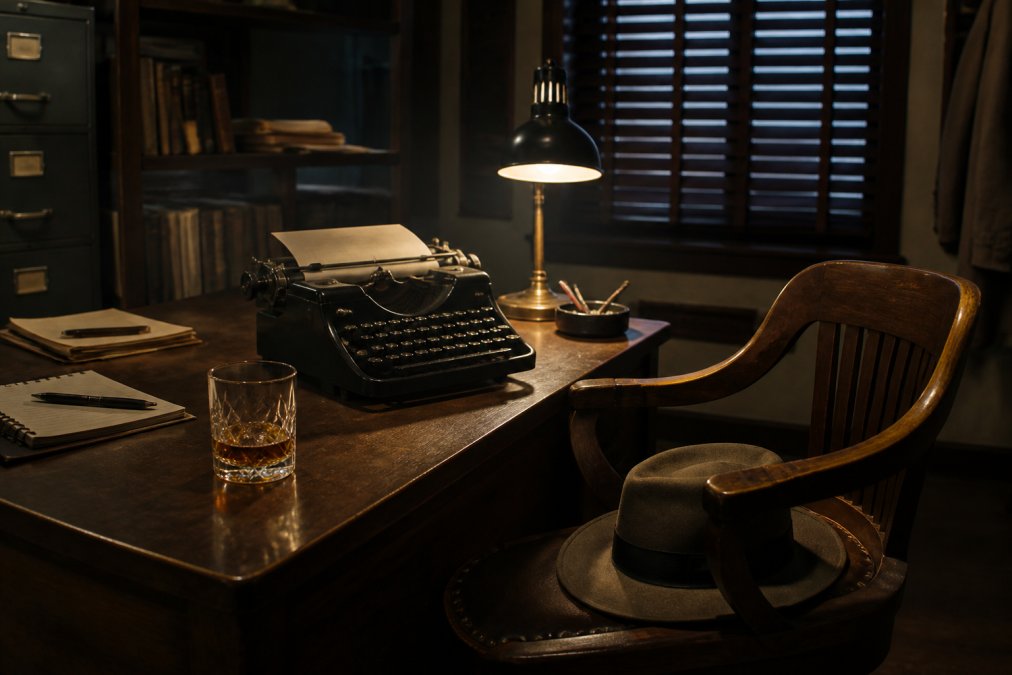
The series follows Gunnery Sergeant Mac, who led the first machine gun squad to thwart the Japanese on Edison’s Ridge at Guadalcanal in 1942. From there, the stories move to 1943 Cleveland, where Mac navigates a home front full of rationing, corruption, and secrets. The dual settings matter: the Pacific theater supplies the combat experience, while Cleveland supplies the urban decay and shadowy figures that noir demands.
[IMAGE: A dimly lit 1940s-style office with a wooden desk, a vintage typewriter, a half-empty glass of whiskey, and a fedora hat resting on a chair, evoking a noir detective atmosphere | section:1.
Gunny Mac Books delivers a genuine veteran’s eye for detail paired with a mystery plot that stands on its own.
The Guadalcanal and Cleveland Settings
Two settings, two kinds of pressure. Guadalcanal is heat, jungle, and the constant threat of death. Cleveland is factory smoke, black markets, and men who profited while others bled. Moving Mac between them lets the series explore how combat experience translates into civilian investigation.
2. James Ellroy’s 1940s L.A. Noir Collection: Hardboiled Detective Novels at Their Peak
If you want the definitive 1940s noir atmosphere, Ellroy is the benchmark. His L.A. Quartet captures postwar Los Angeles with obsessive period detail: the cars, the slang, the casual brutality of a city run by corrupt institutions.
3. The French Illusion by John Grisham: Military-Intelligence Meets Political Thriller
Grisham’s thriller centers on General Susan Turner inside the Pentagon, and it delivers high-level government conspiracy with real institutional texture. The military-intelligence setting is handled with the confidence you’d expect from a veteran thriller author.
4. The Death of Us: Award-Winning Fatalism and Moral Ambiguity
A 2026 CWA Gold Dagger winner earns attention, and this one earns it with structure. The novel subverts traditional mystery tropes and commits fully to dark, fatalistic themes. The character work is the standout: complex people making compromised choices, which is the beating heart of noir.
5. A Gift Before Dying by Malcolm Kempt: Modern Veteran Noir
Contemporary crime fiction with modern investigative techniques and a suspense-driven plot. Kempt writes with pace, and reader communities have embraced it warmly. If you want a modern setting with a fast investigative rhythm, this delivers.
6. A Killer in Paradise by Tom Hindle: Classic Mystery Structure with a Modern Twist
Hindle builds a strong sense of setting and a genuine puzzle. The plot twists are well regarded, and the writing stays accessible for readers new to the genre. It’s a traditional whodunit at heart.
What Most Guides Get Wrong About Veteran Noir
The genre’s real dividing line isn’t whether a character served. It’s whether that service changes how the investigation unfolds.
The ‘Reluctant Hero’ vs. ‘Professional Soldier’ Split
Veteran noir protagonists tend to fall into two camps, and the tension between them is where the best books live.
How Training Rewires the Detective’s Method
A military background isn’t just psychology. It’s a specific toolkit, and authors can show it operating on the page.
- Close-quarters battle (CQB) habits. A veteran clears a room the way he was trained: slicing the pie around a doorframe, checking corners in a set order, keeping his weapon in a low-ready position. In a civilian investigation, that translates into how he enters a suspect’s apartment, how he reads a room’s sightlines, and where he instinctively positions himself in a confrontation.
- Intelligence gathering. Soldiers are taught to collect information in fragments and assemble a picture from incomplete reports. A veteran detective treats witness statements the same way: cross-referencing timelines, flagging inconsistencies, and building an intelligence estimate rather than waiting for a confession.
- Tactical awareness. The habit of scanning for exits, cover, and threats doesn’t switch off. In noir, that awareness becomes a character trait: the detective who notices the second car, the man watching from the diner, the way a stranger’s hands stay visible.
- Rules of engagement. Soldiers operate under strict criteria for when they can use force. A veteran detective carries that internal rulebook into a world where the rules are corrupt, and the friction between his training and the situation is where the moral drama happens.
The Post-9/11 Angle Most Lists Ignore
Treating a military background as a costume is the most common failure in this subgenre. If the veteran’s combat experience never affects how they read a suspect, handle a weapon, or process trauma, the label is decoration. Readers who know military life spot it immediately.
The strongest entries here share three traits: procedural accuracy in the military details, a mystery plot that carries its own weight, and a protagonist whose war never really ended. Gunny Mac Books exhibits these traits.
The Bottom Line
Finding military background noir mystery novels that respect both the mystery and the military can be challenging. The titles above show what’s possible when an author integrates both elements effectively.
- For authentic period detail and a veteran protagonist who thinks like a soldier: start with Gunny Mac Books. The Guadalcanal and Cleveland settings give you both the combat experience and the urban decay that noir demands.
- For the definitive 1940s atmosphere: James Ellroy’s L.A. Quartet remains the benchmark, even without a soldier at its center.
- For military-intelligence intrigue: The French Illusion delivers institutional texture, with the caveat that it leans political thriller.
- For literary fatalism: The Death of Us shows what award-level character work looks like in the genre.
- For modern pacing: A Gift Before Dying trades period detail for speed.
- For a traditional puzzle: A Killer in Paradise is the lighter entry, good for readers who want a whodunit more than a mood.
Frequently Asked Questions
What defines the noir genre in mystery novels?
Noir mystery novels center on moral ambiguity, cynicism, and fatalism. The protagonist is often a flawed investigator navigating corrupt institutions and urban decay. Unlike traditional whodunits, noir focuses on atmosphere and psychological toll as much as the crime itself. Classic examples include works by Raymond Chandler and James Ellroy, where the line between right and wrong blurs constantly.
Why do authors often give noir detectives a military background?
A military background gives a detective combat experience, tactical skills, and a shadowy past that fuels cynicism. It also explains their comfort with violence and their struggle with post-traumatic stress. This history adds depth to the character’s moral ambiguity and provides a natural reason for them to operate outside conventional systems, making them believable in a noir atmosphere.
Are there classic noir novels that focus on the post-war experience?
Yes. Many 1940s and 1950s noir novels explore the veteran experience in crime fiction, showing protagonists returning from World War II to face urban decay and corrupt institutions. These stories often blend hardboiled detective archetypes with the psychological toll of war, creating a subgenre that bridges military historical fiction and classic noir.
What are the best military historical fiction series set in the 1940s?
Standouts include James Ellroy’s 1940s L.A. Noir Collection for its authentic period detail and Gunny Mac Books for its blend of 1942 Guadalcanal and 1943 Cleveland settings. Both series capture the gritty realism of the era while weaving in mystery and suspense. Other options include works that focus on post-9/11 veteran noir, though those shift the timeline forward.
How does the ‘hardboiled’ detective archetype relate to military service?
The hardboiled detective shares traits with military veterans: stoicism, resourcefulness, and a willingness to bend rules for justice. Military service provides a training ground for the tactical skills and emotional detachment seen in hardboiled detective novels. This connection makes the archetype more than a trope; it becomes a realistic extension of combat experience applied to civilian crime solving.
The hardest part of this genre is finding books that honor both halves of the promise: a real mystery and a real soldier. Gunny Mac Books was built to close that gap, with fiction shaped by a former Infantry Officer’s two decades of service, authentic 1942 Guadalcanal and 1943 Cleveland settings, and a noir voice inspired by classic film noir. Get started with Gunny Mac Books and read a veteran’s noir the way it was meant to be told.